
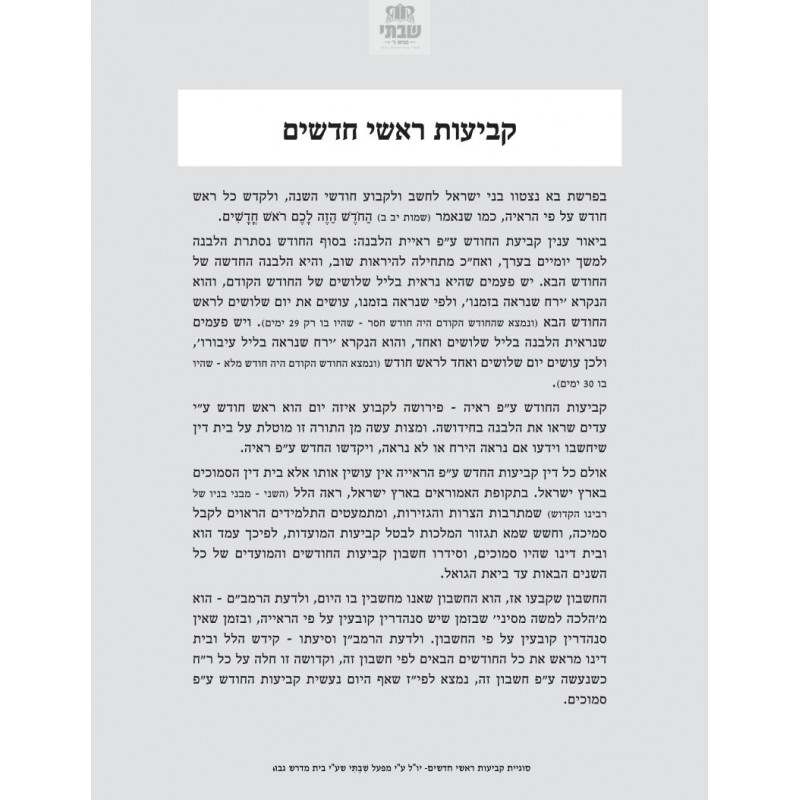
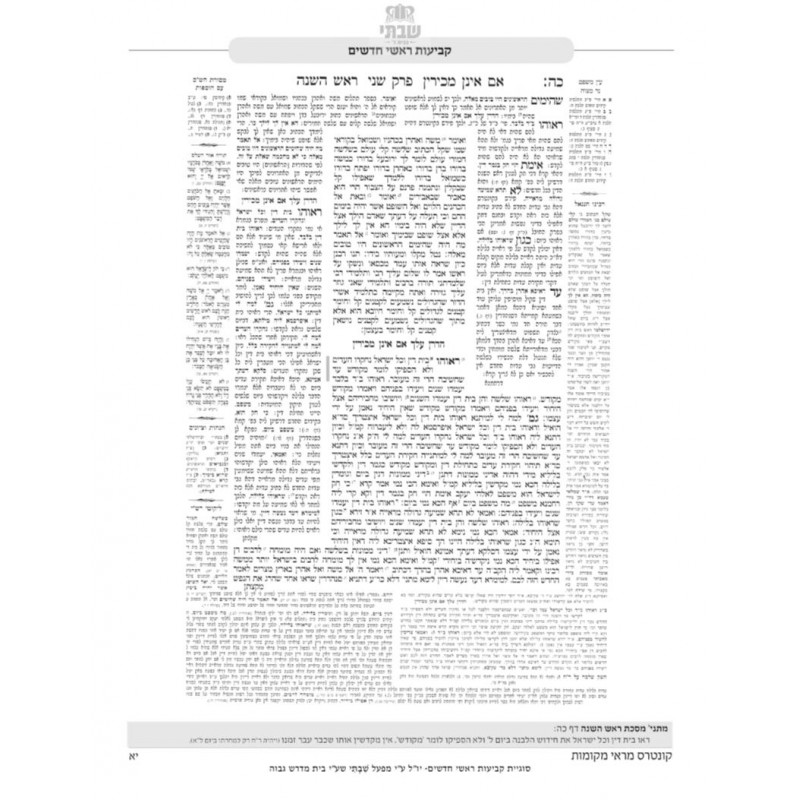
When Hashem created the sun and the moon, the Passuk in Bereishis (1:14) states "Ve'hayu le'osos u'lemoadim u'leyamim ve'shanim" (lit. they shall be for signs, and for festivals, and for days and years). Rashi explains that this refers to the future, when Klal Yisroel will be commanded (in Parshas Bo) to be mekadesh every month based on witness sightings of the new moon, and to fix the Yomim Tovim accordingly.
When the calendar was based on witnesses, months had either 29 or 30 days, depending on when the new moon was sighted. Therefore, over the course of the year, some months were "maleh" (complete) and some were "chaser" (incomplete). Today, these lengths are determined by our fixed calendar.
Some of the topics discussed:
- Why do some months have a 2-day Rosh Chodesh?
- If Rosh Chodesh marks the first day of a new month, how can it last two days?
- Why does one not repeat Shemoneh Esreh if he omitted Ya'aleh V'yavo during Maariv on Rosh Chodesh?
- Is the halacha the same if one forgets Ya'aleh V'yavo on the second night as well?
- What if one forgot to say Ya'aleh V'yavo at Mincha of the first day of Rosh Chodesh, and only realized after the z'man - should he daven Maariv twice?
- What if one forgot Hamelech Hakadosh during Maariv on the first night of Rosh Hashana (which is also Rosh Chodesh Tishrei) - does he repeat Shemoneh Esreh?
- Today, we know the accurate day of Rosh Chodesh (since we go with the established calendar). Why, then, does this din still apply, that one does not daven again if he forgot Ya'aleh V'yavo at Maariv?
- Why don't we keep two days of Yom Kippur because of sfeika d'yoma?
- Do we observe Shavuos based on the calculation of the chodesh (i.e. 6 Sivan), or do we simply count 50 days after Pesach?
| Booklet Details | |
| Pages | 51 |
| Published | 5787 |
| Series | V'yavinu B'Mikreh |
קביעות ראשי חדשים
- Product Code: 331
- Availability: In Stock